


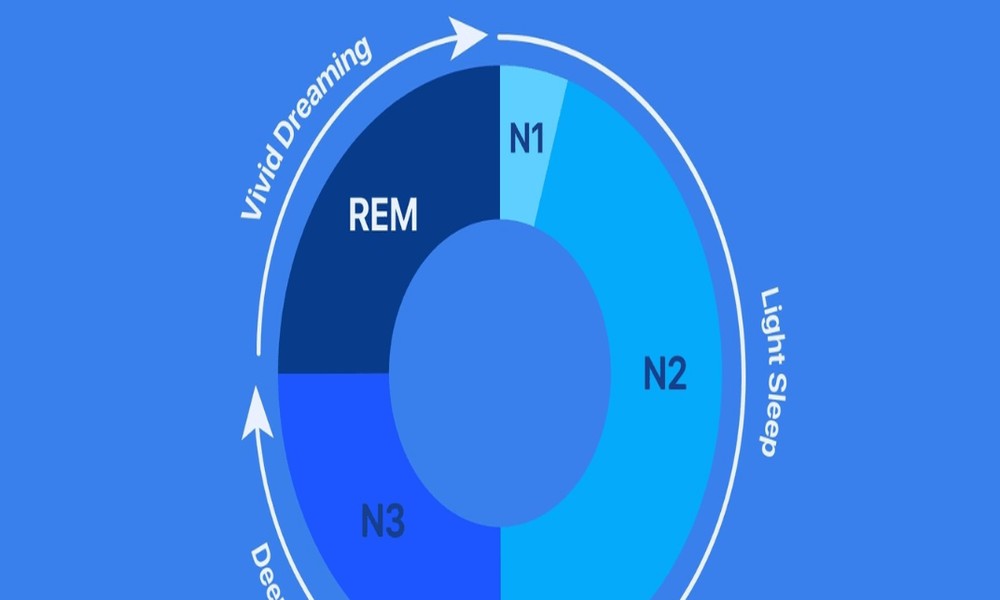
Eight hours of sleep aren’t uniform: animated timelines showing the cycle through deep sleep, REM, and light stages across the night, and how alcohol and caffeine deform this architecture, reveal why consistency and quality matter as much as duration.
You’ve probably heard that you “need eight hours of sleep.” What you’ve heard less about is that those eight hours aren’t uniform. Your brain cycles through different stages of sleep with distinct physiological functions. Spending eight hours in a state where you never reach deep sleep is not the same as eight hours that includes adequate deep and REM sleep. The architecture of your sleep matters as much as the duration.
The Sleep Architecture
> The short version: A Scrollchart sleep timeline shows deep sleep front-loaded early and REM extended late, clarifying why waking early costs disproportionately and why consistency matters more than raw hours.
A typical night follows a progression. You move through sleep stages in cycles, each cycle lasting roughly 90 minutes. Over an eight-hour night, you complete about 5-6 cycles.
Stage 1 (N1): Light sleep, 5-10 minutes. Your eyes close, your muscles relax, and your brain waves slow from waking patterns. You’re transitioning into sleep but could wake easily. This stage is brief.
Stage 2 (N2): Light sleep, 20-30 minutes per cycle. Your brain is producing sleep spindles and K-complexes, burst patterns of brain activity that seem to protect sleep and aid memory consolidation. Your heart rate drops, body temperature falls, and your muscles remain relaxed. You’re harder to wake than in N1, but still easily aroused.
Stage 3 (N3): Deep sleep, 20-40 minutes per cycle (earlier cycles) to almost absent (later cycles). This is where the magic happens. Your brain shows slow-wave activity. Blood pressure drops, metabolism slows dramatically, and growth hormone is released. Deep sleep is when your body repairs muscle damage, consolidates motor memories from training, and flushes metabolic waste from your brain. You’re very hard to wake during deep sleep.
REM (Rapid Eye Movement) sleep, 10 minutes early in the night to 30-60 minutes later in the night. Your eyes move rapidly beneath closed lids. Your muscles are paralysed (except the diaphragm and eye muscles) and your brain looks almost like it does when awake. REM is when most dreaming occurs. Your brain appears to be consolidating emotional memories, processing emotions from the day, and working on creative problem solving.
The Progression Through the Night
The cycle repeats, but the composition shifts:
First two cycles (hours 0-3): Heavy deep sleep, light REM. You need to sleep deeply early because your body’s sleep pressure is highest. REM duration is brief.
Middle cycles (hours 3-6): More balanced, deep sleep declining, REM increasing.
Final cycles (hours 6-8): Minimal deep sleep, predominantly N2 and extended REM. By the end of the night, you might get 45-60 minutes of REM in a single cycle.
This progression explains why early sleep is crucial for feeling rested (deep sleep is highest), but also why cutting sleep short is particularly damaging. An eight-hour sleeper waking at six hours loses not just two hours, but loses almost all the final two REM cycles. The cost is disproportionate to the time lost.
What Each Stage Does
Deep sleep consolidates motor learning and muscle recovery. If you trained hard, deep sleep is when your body repairs muscle fibres and consolidates the neural patterns of new movement. Sleep deprivation specifically blunts this. An athlete sleeping five hours after a hard training session gets less than half the deep sleep of someone sleeping eight hours. Recovery is compromised.
Deep sleep also seems critical for clearing metabolic waste from the brain. The glymphatic system (your brain’s waste clearance) is most active during deep sleep. Chronic sleep deprivation impairs this clearance, and chronic waste accumulation is linked to cognitive decline and neurodegenerative disease.
REM sleep consolidates emotional memories and seems crucial for processing the day’s emotional content and creative problem solving. The brain appears to be working through emotional reactions and integrating learning. Chronic REM deprivation leads to emotional volatility and cognitive issues.
N2 sleep (light sleep) includes brain activity patterns called sleep spindles that seem to protect sleep and consolidate procedural memory (how to do things). It’s less dramatic than deep sleep or REM, but not trivial.
What Disrupts the Architecture
Several factors damage the normal progression:
Alcohol: Suppresses REM sleep, particularly in the first half of the night. You get more light sleep and less of the dream and emotional processing. A drink before bed feels like it helps you sleep faster (true; alcohol is sedating) but costs you REM later.
Caffeine: Keeps you in lighter stages longer and delays deep sleep. Caffeine consumed after noon can still disrupt sleep architecture 12+ hours later because of its long half-life.
Irregular bedtimes: Your circadian rhythm drives the timing of deep and REM sleep. Inconsistent sleep times confuse this rhythm. You might sleep eight hours but never hit deep sleep effectively. Consistency matters as much as duration.
Heat: Your body needs to cool to enter deep sleep. A warm bedroom, warm bedding, or lack of cooling disrupts deep-sleep progression. This is why people often sleep poorly in summer.
Sleep apnoea: Repeated brief awakenings throughout the night fragment sleep architecture. You might spend eight hours in bed but wake so frequently that you never complete normal cycles. You get light sleep without deep sleep and REM consolidation.
Stress and anxiety: Elevate your nervous system arousal, keeping you in light sleep. High cortisol suppresses REM sleep. Chronic stress progressively fragments sleep architecture.
Blue light before bed: Suppresses melatonin, delaying sleep onset and altering the timing of deep-sleep progression. Screen time in the hour before bed is particularly disruptive.
Practical Sleep Architecture Optimization
Understanding architecture explains several practical principles:
Consistency matters enormously: Same bedtime, same wake time, even on weekends. Your circadian rhythm drives deep and REM timing. Consistency lets this system work. One all-nighter destroys sleep architecture for multiple nights afterwards.
Room environment matters: Cool (around 65-68 degrees Fahrenheit or 18-20 degrees Celsius), dark, quiet. Temperature is non-negotiable for deep sleep; this is why people often sleep poorly when visiting other homes.
Avoid alcohol before bed: If you drink, do it with dinner, not after. If you do drink close to bed, expect fragmented REM the first part of the night.
Avoid caffeine after early afternoon: The half-life is 5-7 hours, meaning an afternoon coffee is still 50% present at bedtime.
Get morning light exposure: Sunlight within an hour of waking resets your circadian rhythm and helps consolidate sleep architecture that night.
Exercise improves architecture: Both deep sleep and REM increase with regular exercise. It’s one of the most robust sleep improvements available.
Manage stress deliberately: Meditation, journalling, or therapy genuinely improve sleep architecture by reducing nervous-system arousal.
Why This Matters for Performance and Health
When your sleep architecture is intact (adequate deep sleep for physical recovery and adequate REM for emotional regulation), everything works better:
Recovery from training is faster and more complete. Your muscles repair, your nervous system resets, and motor memories consolidate.
Emotional regulation improves. You’re less reactive, more patient, better able to handle stress. REM sleep is crucial for this.
Cognitive function improves. Memory consolidation, problem-solving, and creative thinking all benefit from complete sleep architecture.
Hunger hormones regulate normally. Sleep fragmentation elevates ghrelin (hunger) and disrupts leptin (satiety), making you chronically hungrier.
Immune function is better. Sleep architecture is directly linked to immune resilience.
The effects of poor architecture are subtle because they accumulate. One bad night barely matters. Months of disrupted architecture adds up, and people often don’t connect the gradual decline in mood, cognitive performance, recovery, and hunger regulation to the sleep disruption that caused it.
Visualising the Night
The power of understanding sleep architecture comes from seeing the actual timeline. When you visualise the first few cycles with deep sleep dominant, then the middle cycles with mixed architecture, then the final cycles with extended REM, the value of a full night’s sleep becomes obvious.
When you see how caffeine pushes sleep onset back and disrupts deep-sleep timing, or how alcohol fragments REM later in the night, the chemical effects become intuitive. Animated charts showing the progression through the night, the deepening and lightening as cycles progress, the composition of deep sleep versus REM changing across the night, makes the architecture concrete in a way that words alone can’t convey. Tools like Scrollchart can show how disruptions (alcohol, heat, stress, poor sleep hygiene) deform the normal architecture, why consistency matters, and why seven consistent hours of good architecture can sometimes feel better than nine hours of fragmented architecture.
The Practical Takeaway
You don’t just need eight hours of sleep. You need eight hours of sleep that includes substantial deep sleep (especially in the first half of the night) and adequate REM (which dominates later cycles). You need consistent timing, a cool environment, minimal disruptions, and protection from substances that fragment the architecture.
The architecture determines whether eight hours genuinely restores you or leaves you depleted. Get the architecture right, and seven consistent hours often feels better than ten disrupted hours. Ignore it, and you can spend your whole life partially sleep-deprived without quite understanding why you feel persistently flat.
Frequently asked questions
Why do sleep disruptions feel so much worse than I’d expect from the lost time?
You don’t just lose sleep duration; you lose the specific stages you were in. Waking at six hours after starting at eleven means you lose almost all the final REM cycles, where the longest and most emotionally restorative REM occurs. The cost of two lost hours is disproportionate because those specific hours are highest in REM. A Scrollchart showing REM accumulation across the night makes this clear.
Does alcohol really disrupt sleep if it helps me fall asleep?
Yes. Alcohol is sedating but suppresses REM, particularly early in the night. You fall asleep faster but lose emotional processing and creative consolidation. You wake up having slept eight hours but without adequate REM recovery. A Scrollchart overlay showing normal architecture versus alcohol-disrupted architecture reveals how a sedative at bedtime actually impairs the quality of sleep itself.
How much does temperature really matter for sleep quality?
Substantially. Your body needs to cool to enter deep sleep; heat prevents deep-sleep progression. A cool room (around 65-68 degrees Fahrenheit or 18-20 degrees Celsius) is non-negotiable for architecture. Animated timelines showing deep-sleep architecture in a cool room versus a warm room clarify why temperature is a lever, not a minor detail.
